
T+1 at a Glance
What does T+1 mean?
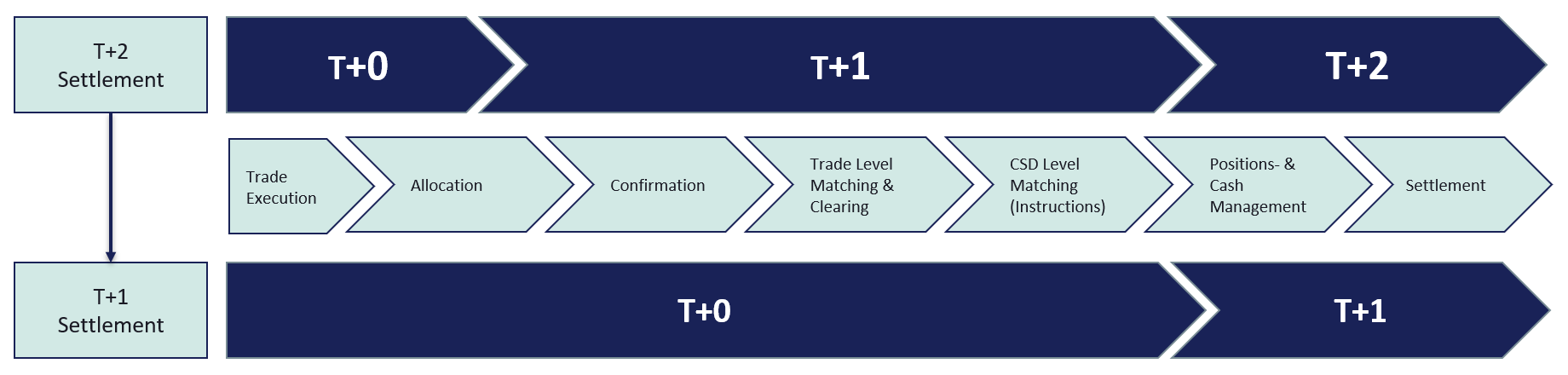
T+1 stands for "Trade Date plus 1 Business Day". This means that securities transactions will be settled one business day after the trade date in the future.
For the European capital market, this represents a reduction of the current standard settlement cycle from T+2 to T+1. As a result, the timeframe for all post-trade processes is shortened, particularly for allocations, confirmations, the transmission of settlement instructions, and the provision of the required cash liquidity.
Why is the transition taking place?
The introduction of T+1 aims to further increase the efficiency and resilience of securities markets.
By shortening the period between trade execution and settlement, risks are reduced and capital becomes available more quickly. At the same time, the transition promotes the standardization and automation of market processes as well as the international harmonization of capital markets.
In addition, the early adoption of standardized electronic allocation and confirmation processes is intended to establish the prerequisites for a successful implementation of T+1.
Which markets and transactions are affected?
European securities markets are currently preparing for the introduction of the shortened T+1 settlement cycle. In the future, securities transactions in the European Union, the United Kingdom, and Switzerland will be settled one business day after the trade date (T+1) instead of the current two business days (T+2).
The requirements for allocations and confirmations apply both to exchange-traded transactions in equities, bonds, and fund units covered by the T+1 settlement cycle, as well as to OTC securities transactions, repo transactions, and securities lending transactions.
The affected market participants are those classified as Professional Clients or Eligible Counterparties under MiFID II.