

Climate and Environmental Topics at NORD/LB
Climate and environmental topics form part of our ESG Strategy and ESG risk management. In our business activities, we take into account regulatory requirements, sector-specific developments and defined ESG criteria. For selected emissions-intensive sectors, we have developed Transformation Guidelines and corresponding targets. We also support customers with selected transformation projects and financing with sustainability-related features. The applicable NORD/LB criteria and frameworks are decisive in this context.
Financing with Sustainability-Related Features & Relevant Future-Oriented Sectors
Our activities with sustainability-related features are guided by NORD/LB's strategic direction, the applicable internal criteria and regulatory requirements. At the same time, we monitor technological, market and regulatory developments and assess which changes may be relevant to our business areas and customers. The resulting insights feed into our analyses, internal management and the further development of our activities.
Measuring and Assessing Greenhouse Gas Emissions
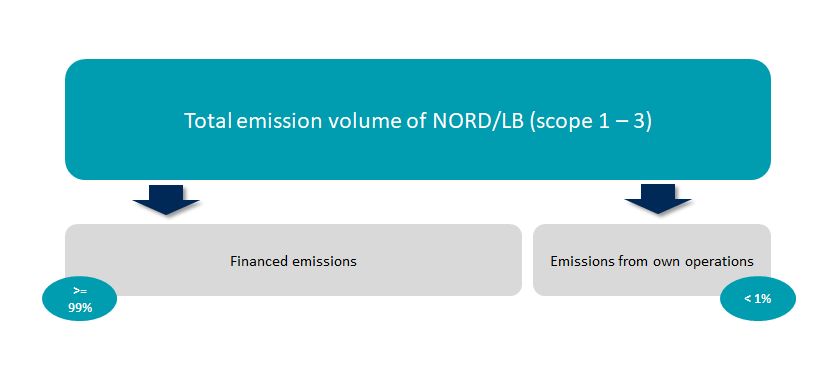
We measure greenhouse gas emissions from our own operations as well as financed emissions from our lending and financing business. Financed emissions account for the majority of the emissions measured.
For their quantification, we use the PCAF methodology, among other approaches. The results feed into our analysis of climate-related risks and the further development of our management approaches.
As part of our sustainability reporting, we report relevant greenhouse gas emissions in accordance with the applicable regulatory requirements and reporting standards.
Source: CSRD Report
While emissions from our own operations arise primarily from energy consumption, mobility and building operations, financed emissions account for the majority of our climate-related impacts. Measuring and assessing them therefore provides an important basis for evaluating climate-related risks and developing appropriate management approaches.
As part of our sustainability reporting, relevant greenhouse gas emissions, stated in CO₂ equivalents, are measured, analysed and disclosed in accordance with the Corporate Sustainability Reporting Directive (CSRD) and the applicable European Sustainability Reporting Standards (ESRS). CSRD-compliant reporting provides a consistent and traceable data basis for transparently presenting climate-related impacts, risks and management approaches.
Our own emissions
On this basis, we derive measures to reduce operational emissions, for example by purchasing electricity from renewable energy sources, implementing measures to improve energy efficiency in buildings, optimising space utilisation and adapting mobility concepts. ISO 50001 certification also supports our energy management system in making energy consumption transparent and systematically further developing energy efficiency measures.
Emissions are accounted for across the three emissions scopes:
- Scope 1: Direct CO₂ emissions from NORD/LB's own emission sources at its locations, for example from the combustion of fossil fuels (natural gas) and operation of the vehicle fleet.
- Scope 2: Indirect CO₂ emissions from the generation of purchased energy such as electricity or district heating.
- Scope 3: Other indirect CO₂ emissions along the value chain, for example from business travel, paper and water consumption, and waste.
Systematic data collection provides the basis for transparent analysis and the further development of management approaches to reduce emissions from NORD/LB's own operations.
10.805 tCO₂e
Scope-1 & Scope-2
emissions 2025
88,5 %
of the company car fleet will be fully electrified in 2025

ESG Risk Management
We assess climate- and nature-related risks that may be relevant to our customers, portfolios, and business environment. The findings are considered in selected risk management and portfolio management processes, including risk identification, credit assessment, risk strategy, and monitoring activities. Areas of focus include transition and physical climate risks as well as biodiversity-related risks.
ESG-related risk factors are assessed through an internal ESG scoring approach and complementary analyses, including sector and scenario analyses. The resulting information supports risk management, credit assessment, and strategic planning processes and is regularly reviewed through internal reporting.